Al-Balad Historic District
Wander Al-Balad and you step straight into Jeddah's old town on the Red Sea, built up over more than a thousand years as the sea gate to Makkah. UNESCO added it to the World Heritage List in 2014 under the name Historic Jeddah, the Gate to Makkah, Saudi Arabia's third site on the list, for its coral-stone houses, carved wooden roshan windows and its unbroken role receiving pilgrims and traders (source: UNESCO World Heritage Centre, whc.unesco.org/en/list/1361/, accessed 2026-09-08).
What is Al-Balad and why does UNESCO protect it?
People have lived and traded on this stretch of Red Sea coast since the 7th century. Jeddah grew as a port for Indian Ocean shipping and, crucially, as the point where pilgrims arriving by sea stepped onto Arabian soil before continuing to Makkah (source: Wikipedia; National Council on U.S.-Arab Relations, accessed 2026-09-08). That double role, trading city and pilgrim gateway, shaped everything about how the old town was built.
UNESCO inscribed the district in 2014 as "Historic Jeddah, the Gate to Makkah" (reference no. 1361), making it Saudi Arabia's third World Heritage Site (source: Jeddah Historic District Program, jeddahalbalad.sa; Al Arabiya English, 22 June 2014, accessed 2026-09-08). The committee's reasoning centred on the exchange of building materials and craft techniques around the Red Sea over centuries, on Jeddah standing as one of the last largely intact urban ensembles from that trading world, and on the district's deep, ongoing ties to the Hajj.
Planning your visit
Al-Balad rewards exploring on foot: the lanes are narrow and atmospheric, and once you are inside them a car will not get you any closer to the coral-stone houses. Mornings and the hours after sunset are the most comfortable times to wander, once the midday sun on unshaded coral walls has eased off, and evenings also bring the souk lanes properly to life. Pack modest, comfortable clothing, in keeping with the rest of Saudi Arabia. A local guide is worth arranging if you want the history behind specific houses rather than just the streets themselves; several licensed operators run walking tours through the Jeddah Historic District. See Tours & Activities for options, and Things to Do for how Al-Balad fits into a wider day in Jeddah.
Inside the old town
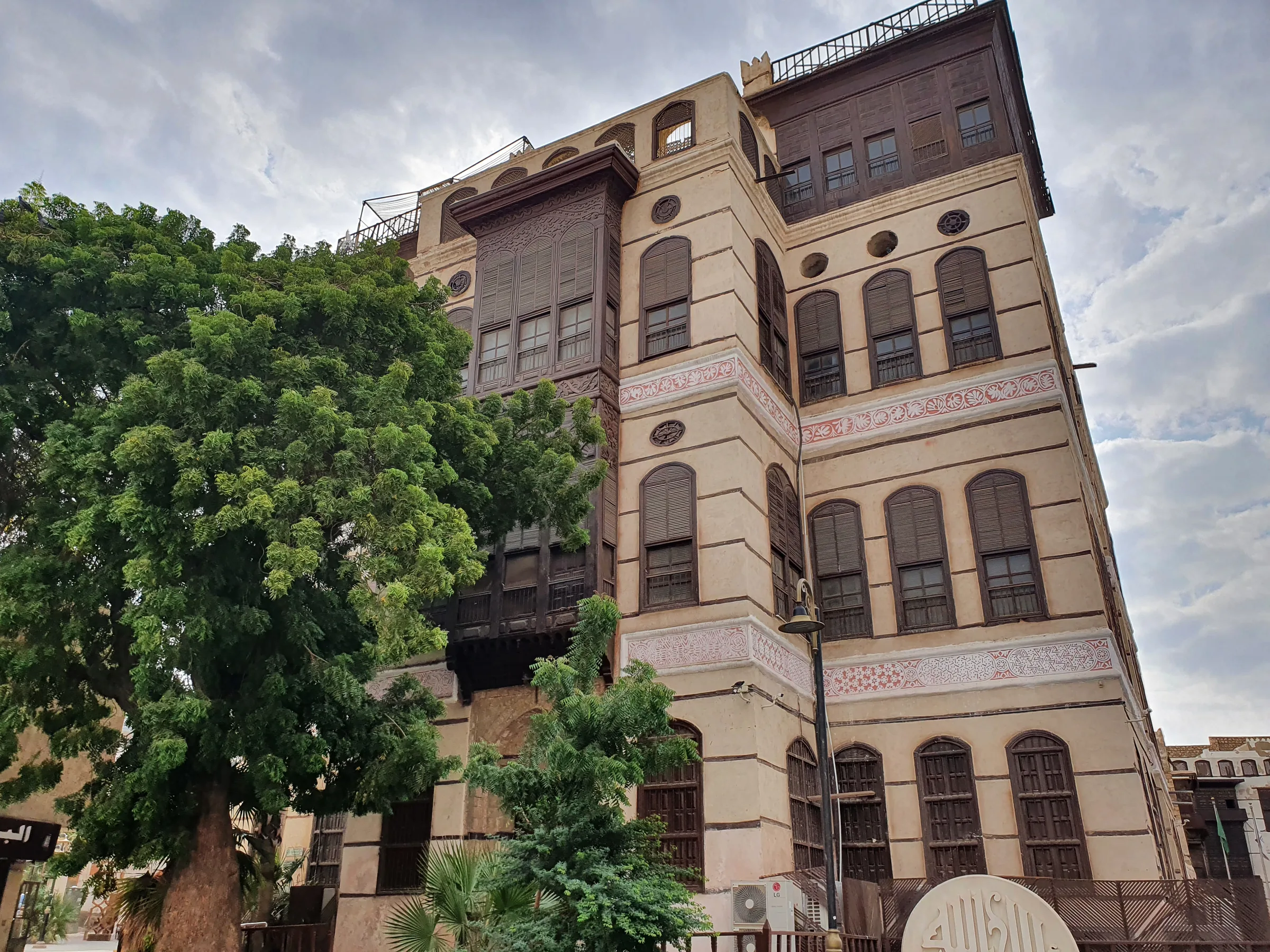
Coral-stone houses
Al-Balad's merchant houses are built from coral limestone quarried along the Red Sea shore and bound with lime and mud, a construction method unique to this coast. Some of the tallest surviving houses rise past 30 metres and are still standing after well over a century (source: Wikipedia; Saudipedia, accessed 2026-09-08).
Photo: Richard Mortel, CC BY 2.0 via Wikimedia Commons

Roshan windows
Projecting wooden bay windows, known as roshan or rawasheen, cover almost every historic facade. Carpenters cut and fitted the lattice screens without nails, so air moves through while the street outside cannot see in; the finer examples carry carved detailing and small panels of coloured glass.
Photo: Jpatokal, CC BY-SA 4.0 via Wikimedia Commons
Naseef House
Built in 1872 by the merchant Sheikh Omar Effendi Nassif on Souk Al-Alawi, this is Al-Balad's best-known coral mansion. King Abdulaziz stayed here after entering Jeddah in December 1925, receiving citizens and signing agreements with foreign delegations during the unification of the Kingdom. A large tree still grows by its entrance, and locals refer to the house by it. It now works as a cultural and exhibition space within the Jeddah Historic District (source: Saudipedia; Saudi Cultures, accessed 2026-09-08). Behind the house, Nassif House Square is also home to Zawiya 97, a working craft studio founded by artist and architect Ahmed Angawi, where visitors can watch or try their hand at woodworking and other traditional Hejazi crafts alongside resident artisans; treat exact hours and walk-in access as unconfirmed and check current programming before planning a visit around it (source: Destination KSA, "Zawiya 97: Nurturing Creativity in Jeddah's Historic Heart"; Arab News, Balad Al-Fann festival coverage, 2025, accessed 2026-09-08).
- Official site
- No independent website; managed within the Jeddah Historic District Program, jeddahalbalad.sa
- Location
- Souk Al-Alawi, Al-Balad, Jeddah
- Address
- Secondary sources additionally cite "Al Dhahab, Al-Balad, Jeddah 22236" as the specific lane; not confirmed against an official address registry
- Coordinates
- 21.48389°N, 39.18778°E
- Phone
- Not publicly confirmed
- Hours
- One secondary source reports 08:00–23:55, Monday–Saturday; not corroborated by a second source or by the Jeddah Historic District Program's own site, treat as unconfirmed
- Source
- Wikipedia, "Nasseef House", accessed 2026-09-08 (coordinates); Saudipedia, accessed 2026-09-08 (history and current use)
- Confidence
- Medium location/history · Low hours/phone
Souk Al-Alawi and the merchant houses
This is one of Jeddah's oldest markets, cutting straight through Al-Balad past Naseef House and other old merchant homes such as Beit Al-Matbouli. Perfume and spice sellers still trade here alongside textiles, antiques and household goods, a continuation of the pilgrim-era commerce the street was built for (source: Visit Saudi, visitsaudi.com, accessed 2026-09-08).
Restoration and new heritage hotels
In 2019 the Saudi government pledged around $13.3 million to restore 56 buildings identified as at risk of collapse. The Jeddah Historic District Program, set up to run the site's preservation under Vision 2030, opened Al-Balad's first heritage hotels inside restored historic houses in 2024 (source: Wikipedia; Jeddah Historic District Program, jeddahalbalad.sa, accessed 2026-09-08).
A $3.6 billion hospitality investment, 2025 to 2038
Al Balad Development Company, a subsidiary of Saudi Arabia's Public Investment Fund, announced a $3.6 billion hospitality investment portfolio in November 2025 to restore and build hotel assets across Historic Jeddah, targeting more than 3,300 hotel units from budget to luxury, phased through 2038 and funded through public-private partnerships and dedicated investment funds. The company states that new development follows heritage design guidelines meant to keep the coral-stone Hejazi character intact rather than replace it (source: Al Arabiya English, 11 November 2025; Arab News, 2025, accessed 2026-09-08). Part of that approach is already visible on the ground: Al Balad Hospitality has converted 19th-century merchant houses, including Beit Kedwan, into small boutique stays instead of demolishing them, the same reuse-over-demolition logic already applied to Naseef House (source: Jeddah Historic District Program, jeddahalbalad.sa/our-nitiatives/heritage_and_hospitality; Al Balad Hospitality, albaladhospitality.com, accessed 2026-09-08). Nightly rates move often; check current availability through the operator's own site or a booking partner rather than an older published figure.
How to visit Al-Balad respectfully
Walking Historic Jeddah feels easy and unhurried, partly because the district actively manages its visitor flow rather than leaving it to chance. Sustainability research on the district frames that management around four things: how many people a site can hold safely, how crowding changes the quality of a visit, whether staff and infrastructure can keep pace with demand, and the active steps, such as routing and pedestrianisation, that keep the first three in balance (source: Sampieri and Bagader, "Sustainable Tourism Development in Jeddah: Protecting Cultural Heritage While Promoting Travel Destination," Sustainability, vol. 16, no. 9148, 2024, doi.org/10.3390/su16219148, accessed 2026-09-08). In practice, that means Al-Balad's core is already a car-free, walkable zone with marked tourist routes, more than 150 trained multilingual guides working the district and a visible security presence in the busier lanes. Visitors do not need to plan much around this beyond the basics: stay on the marked routes, book a guide if you want the history behind specific houses, and expect extra footfall and security presence in Souk Al-Alawi after sunset, when the district is busiest.
Frequently Asked Questions
What is Al-Balad and why is it a UNESCO World Heritage Site?
Al-Balad is Jeddah's historic old town, inhabited since the 7th century as a Red Sea trading port and the main sea gateway for pilgrims travelling to Makkah. UNESCO inscribed it in 2014 under the name Historic Jeddah, the Gate to Makkah, Saudi Arabia's third World Heritage Site, citing its coral-stone building traditions and its role as a trading and pilgrimage hub (source: UNESCO World Heritage Centre, whc.unesco.org/en/list/1361/; Jeddah Historic District Program, jeddahalbalad.sa, accessed 2026-09-08).
What is Naseef House?
Naseef House (Bayt Nassif) is a coral-stone merchant mansion on Souk Al-Alawi, built in 1872 by the Jeddah merchant Sheikh Omar Effendi Nassif. King Abdulaziz stayed there after entering Jeddah in December 1925 during the unification of Saudi Arabia, using it to receive citizens and sign agreements with foreign delegations. It now serves as a cultural landmark within the Jeddah Historic District (source: Saudipedia; Wikipedia, accessed 2026-09-08).
What are roshan windows?
Roshan (rawasheen) are projecting wooden lattice bay windows carved and assembled without nails, a signature feature of Hejazi coral-stone houses in Al-Balad. They shade interiors, let air move through the lattice while screening residents from the street, and are often finished with fine joinery and small coloured glass panes (source: Wikipedia; Saudi Cultures, accessed 2026-09-08).
What is Souk Al-Alawi?
Souk Al-Alawi is one of Jeddah's oldest markets, running through the centre of Al-Balad past historic merchant houses including Naseef House and Beit Al-Matbouli. It trades in perfume, spices, textiles and antiques, and its own history is tied to the pilgrim trade that passed through Jeddah for centuries (source: Visit Saudi, visitsaudi.com, accessed 2026-09-08).
Is Al-Balad walkable?
Yes. Historic Jeddah's core is a car-free, pedestrian zone with marked walking routes linking its main sites, so a car will not get you closer once you are inside the lanes (source: Sampieri and Bagader, Sustainability, vol. 16, no. 9148, 2024, accessed 2026-09-08).
Do I need a guide in Historic Jeddah?
Not strictly, but it helps. More than 150 trained multilingual guides work in Al-Balad, and a guide will generally get you more of the history behind specific coral-stone houses than a self-guided walk (source: Sampieri and Bagader, Sustainability, vol. 16, no. 9148, 2024, accessed 2026-09-08).
Continue exploring: Jeddah Corniche sits a short ride from the old town along the waterfront, and Jeddah Facts covers the city's wider history beyond Al-Balad.
Sources
- UNESCO World Heritage Centre, "Historic Jeddah, the Gate to Makkah" (whc.unesco.org/en/list/1361/). Accessed 2026-09-08.
- Jeddah Historic District Program, official site (jeddahalbalad.sa/about-us). Accessed 2026-09-08.
- Wikipedia, "Al-Balad, Jeddah." Accessed 2026-09-08.
- Saudipedia, "Nassif House." Accessed 2026-09-08.
- Visit Saudi, official Saudi tourism authority (visitsaudi.com), "Souq Al Alawi." Accessed 2026-09-08.
- Saudi Cultures, "Al Balad: Jeddah's Historic Quarter of Coral and Kings." Used for descriptive detail alongside the sources above. Accessed 2026-09-08.
- National Council on U.S.-Arab Relations blog, "Jeddah, Al-Balad, The Town." Used for descriptive detail alongside the sources above. Accessed 2026-09-08.
- Al Arabiya English, "Jeddah Historical Area joins list of U.N. World Heritage sites," 22 June 2014.
- Al Arabiya English, "Saudi Arabia's Al Balad Development launches $3.6 bln investment portfolio," 11 November 2025. Accessed 2026-09-08.
- Arab News, "PIF-owned Al Balad Development unveils $3.6bn plan to develop Historic Jeddah," 2025. Accessed 2026-09-08.
- Jeddah Historic District Program, official site, "Heritage and Hospitality" (jeddahalbalad.sa/our-nitiatives/heritage_and_hospitality). Accessed 2026-09-08.
- Al Balad Hospitality, official site (albaladhospitality.com), Beit Kedwan listing. Accessed 2026-09-08.
- Destination KSA, "Zawiya 97: Nurturing Creativity in Jeddah's Historic Heart." Accessed 2026-09-08.
- Arab News, "Artistic experiences enchant Balad Al-Fann visitors," 2025. Accessed 2026-09-08.
- Sampieri, S. and Bagader, M. (2024). "Sustainable Tourism Development in Jeddah: Protecting Cultural Heritage While Promoting Travel Destination." Sustainability, 16, 9148. doi.org/10.3390/su16219148, published under CC BY 4.0; findings paraphrased in original wording, not quoted. Accessed 2026-09-08.
Facts here reflect the sources above as of the access date. Restoration work and visitor access inside individual heritage houses can change; confirm current opening arrangements locally before planning a visit around a specific building.