Jeddah Corniche
Jeddah's Corniche runs along the Red Sea as both a coastal road and a public promenade, linking a floating mosque, an open-air sculpture trail and King Fahd's Fountain, a seawater jet widely cited as one of the tallest fountains in the world (source: Wikipedia, accessed 2026-09-08).
How long is the Corniche, and where does it run?
Wikipedia's own summary calls the Jeddah Corniche a 30-kilometre coastal stretch, while the same article's infobox lists a more specific 4.2 kilometres for the modern, purpose-built waterfront section (source: Wikipedia, Jeddah Corniche, accessed 2026-09-08). Both figures are accurate, they simply describe different stretches of the same coastline. The 30km number covers the full run of coastal road and recreation land Jeddah has developed since the 1970s. The 4.2km figure is the newer, heavily landscaped "New Jeddah Corniche" near the city centre, inaugurated on 30 November 2017 by Makkah Governor Prince Khaled Al-Faisal after a reported $212.3 million redevelopment (source: Wikipedia, accessed 2026-09-08). A separate travel guide puts the same modern stretch at roughly 4.5km, close enough to count as the same measurement taken slightly differently (source: Kupi, accessed 2026-09-08). Treat "30km" as shorthand for the whole Corniche and "4.2 to 4.5km" as the walkable core most visitors mean when they say they are heading to the waterfront.
Corniche quick facts
| Fact | Detail |
|---|---|
| Full Corniche length | About 30km (informal figure) |
| New Jeddah Corniche (central waterfront) | 4.2 to 4.5km, opened 30 November 2017 |
| Sculpture collection area | Roughly 7km, Al-Hamra district, about 20 works on display |
| King Fahd's Fountain height | 312m / 1,024ft widely cited; some sources say 260m |
| Fountain fully operational since | 1985 |
Table compiled from Wikipedia, Arab News and Kupi, accessed 2026-09-08.
When is the best time to walk the Corniche?
Mornings and evenings are when the Corniche is at its best, with cooler, more comfortable light for the fountain and the sculpture trail, well worth planning around since Jeddah's Red Sea coast runs hot and humid for much of the year. Sunset over the water is when Al-Rahmah Mosque earns its "floating" nickname most convincingly.
What can you do along the Corniche?
King Fahd's Fountain
A seawater jet fired from a platform just off the coast, visible across much of the city on a clear day. The height breakdown below has the full story, so you can share the right number with confidence (source: Wikipedia; Arab News, accessed 2026-09-08).
The open-air sculpture collection
Around 20 large-scale works by international and Saudi artists sit along roughly 7km of the Corniche in the Al-Hamra district, the surviving core of a project that once commissioned hundreds of pieces citywide (source: Wikipedia; Arab News, accessed 2026-09-08).
Al-Rahmah Mosque, the "Floating Mosque"
Built in 1985 on pillars set into the Red Sea seabed at the Corniche's northern tip, the mosque appears to hover on the water at high tide, especially around sunrise and sunset (source: Atlas Obscura; Zamzam, accessed 2026-09-08).
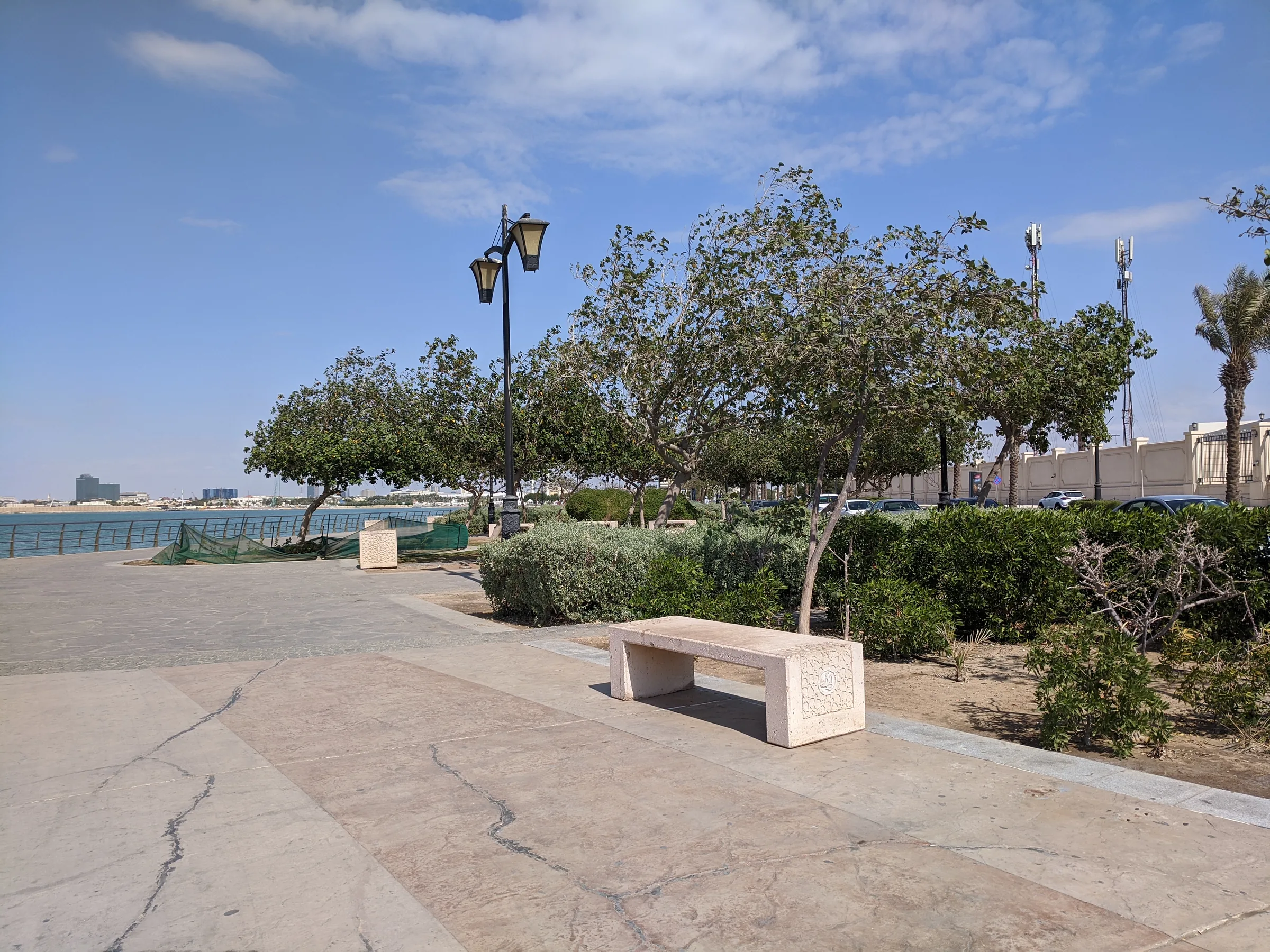
New Jeddah Corniche waterfront
The redeveloped central stretch adds an aquarium, a cultural centre, gardens, three sandy beaches, children's play areas and a dancing fountain across 730,000 square metres of landscaped waterfront (source: Wikipedia, accessed 2026-09-08).
Jeddah Corniche Circuit
A temporary street circuit built into the Corniche road network has hosted Formula 1's Saudi Arabian Grand Prix since December 2021, closing sections of the waterfront on race weekend (source: Wikipedia, accessed 2026-09-08).
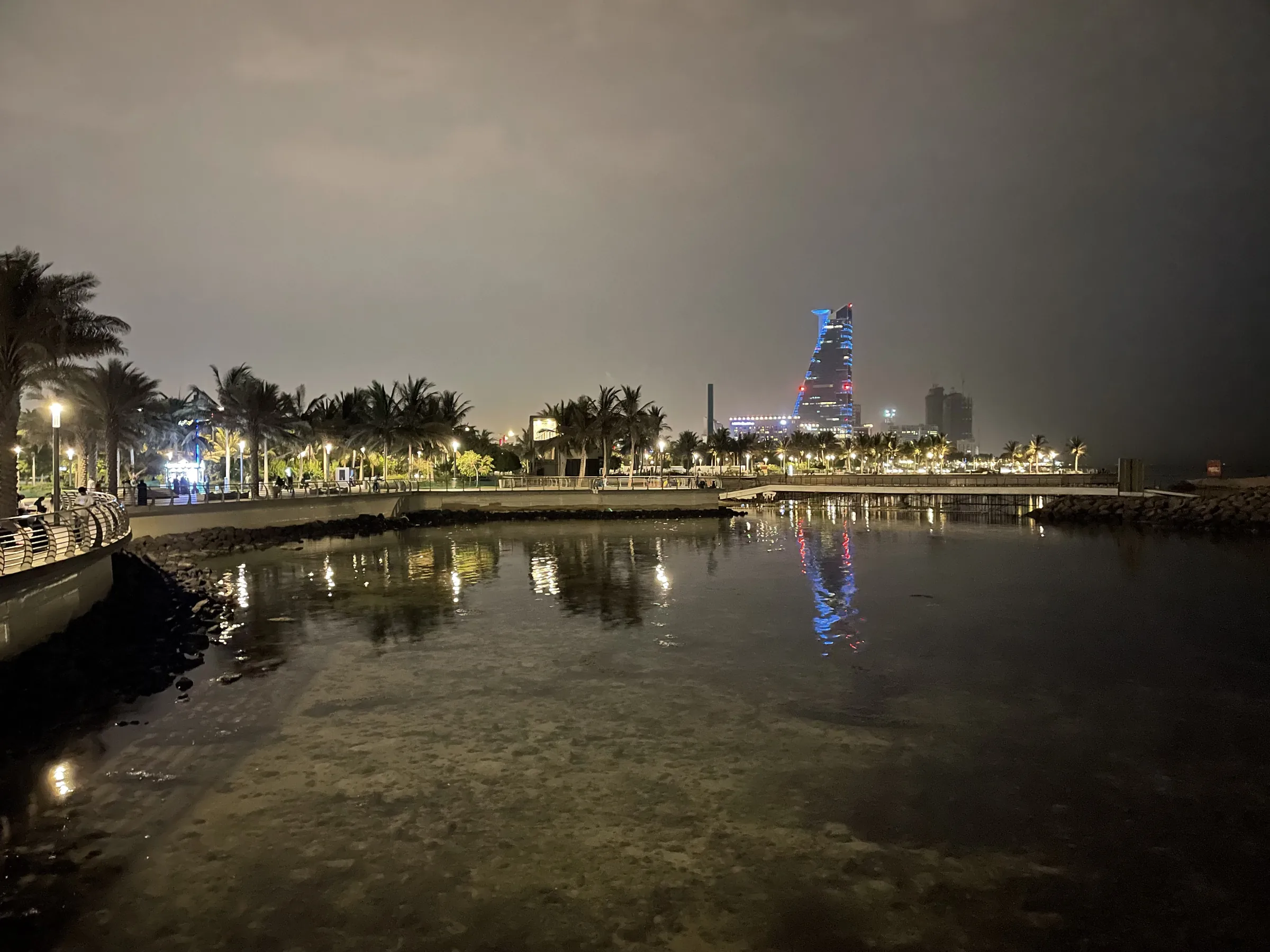
Waterfront dining
Restaurants and cafes line several stretches of the promenade, clustered mostly around the New Jeddah Corniche and Al-Hamra. The mix changes often enough that it is worth checking current listings before planning a specific meal there.
Photo: Joseph Azzak, CC BY-SA 4.0 via Wikimedia Commons
King Fahd's Fountain: how tall is it, really?
Decorative placeholder, not a photograph. See the TODO at the top of this file.
Multiple sources put King Fahd's Fountain at 312 metres (1,024 feet), including Wikipedia and Arab News, both crediting the figure to Guinness World Records (source: Wikipedia; Arab News, accessed 2026-09-08). A handful of other write-ups mention 260 metres instead. That lower figure looks like an earlier or reduced operating height rather than a different fountain: once the pumps run at full pressure, the sources that report a specific number converge on 312m. The most reliable way to put it: 312m/1,024ft is the figure that shows up again and again across sources, while 260m still appears in a handful of accounts as a secondary or historical number, absent a direct check of Guinness's own database.
Water leaves the nozzle at up to 375 km/h (233 mph). Estimates for how much water hangs in the air at any given moment range from roughly 16 to 18 tonnes, depending on the source (source: Wikipedia; Arab News; Outdoor Fountain Pros, accessed 2026-09-08). The fountain runs on pumped seawater, not fresh water, drawn straight from the Red Sea beside it. Construction dates to the early 1980s, with the fountain becoming fully operational in 1985 (source: Wikipedia; Time Out Jeddah, accessed 2026-09-08). After dark the jet is lit from below by more than 500 LED spotlights, turning the plume into one of the most visible landmarks along the whole Corniche (source: Saudipedia, King Fahd's Fountain; Exploring Saudi, accessed 2026-09-08).
The open-air sculpture collection
Decorative placeholder, not a photograph. See the TODO at the top of this file.
Jeddah's public sculptures trace back to September 1974, when mayor Mohamed Said Farsi and Spanish architect Julio Lafuente set out to turn the city's streets and roundabouts into what Farsi called an arena of public art. Over 400 works were eventually commissioned, most of them placed along the Corniche (source: Wikipedia, Jeddah Beautification Project, accessed 2026-09-08).
Decades of salt air took a toll on the steel and stone. By the early 2000s many pieces had corroded badly enough that Abdul Latif Jameel Community Initiatives, under president Fadi Jameel, began a restoration programme around 2011 with Jeddah Municipality. Some sculptures were refurbished where they stood; others went to a workshop and were later reinstalled (source: Arab News, accessed 2026-09-08). The result is the Jeddah Sculpture Museum, an open-air museum near Al Anani Mosque where around 20 of the surviving works are now grouped along roughly 7km of the Corniche in the Al-Hamra district (source: Arab News, accessed 2026-09-08).
Names attached to specific pieces include Alexander Calder's "Flexibility of Balance," Victor Vasarely's "Balance in the Air" and Joan Miro's "The Bird," also known by its French title "Oiseau" (source: Wikipedia, Jeddah Beautification Project, accessed 2026-09-08). Henry Moore, Cesar Baldaccini and Jean Arp all contributed work to the wider collection too, alongside Saudi and regional artists including Mustafa Sunbul and Rabia Al Akhras (source: Wikipedia; Arab News, accessed 2026-09-08). Restoration is an ongoing project, so treat the collection as a living one: most works are on view at any given time, with an occasional piece away for care.
Practical info
The Corniche itself charges no entrance fee and keeps no fixed hours, since it is a public road and promenade rather than a ticketed attraction, so you're free to wander it whenever you like. Individual venues along it, the aquarium, the cultural centre, the beaches and any organised boat trips, set their own prices and schedules. Timing a visit around a Formula 1 race weekend at the Jeddah Corniche Circuit adds race-day energy to the waterfront, just plan around the road closures and reduced access to some stretches during the event (source: Wikipedia, accessed 2026-09-08).
Frequently Asked Questions
How long is the Jeddah Corniche?
Wikipedia's own summary describes it as a 30km coastal stretch, while its infobox lists 4.2km for the newer, purpose-built central waterfront that opened in November 2017. Both figures are accurate; they describe different sections of the same coastline (source: Wikipedia, Jeddah Corniche, accessed 2026-09-08).
How tall is King Fahd's Fountain, and is it really the tallest in the world?
Most sources, including Wikipedia and Arab News, put it at 312 metres (1,024 feet) and credit the figure to Guinness World Records. A smaller number of write-ups cite 260 metres instead, likely describing an earlier or lower operating height rather than a separate structure (source: Wikipedia; Arab News, accessed 2026-09-08).
What is the open-air sculpture collection along the Corniche?
Around 20 large-scale sculptures sit along roughly 7km of the Corniche in the Al-Hamra district, the restored core of a beautification project begun in 1974 that once commissioned over 400 works citywide. Documented artists include Alexander Calder, Victor Vasarely and Joan Miro (source: Wikipedia, Jeddah Beautification Project; Arab News, accessed 2026-09-08).
Is the Jeddah Corniche free to visit?
Yes. The road and promenade are open public space with no entrance fee and no fixed hours. Individual attractions along it, such as the aquarium, the cultural centre or organised boat trips, set their own prices and schedules (source: Wikipedia, accessed 2026-09-08).